

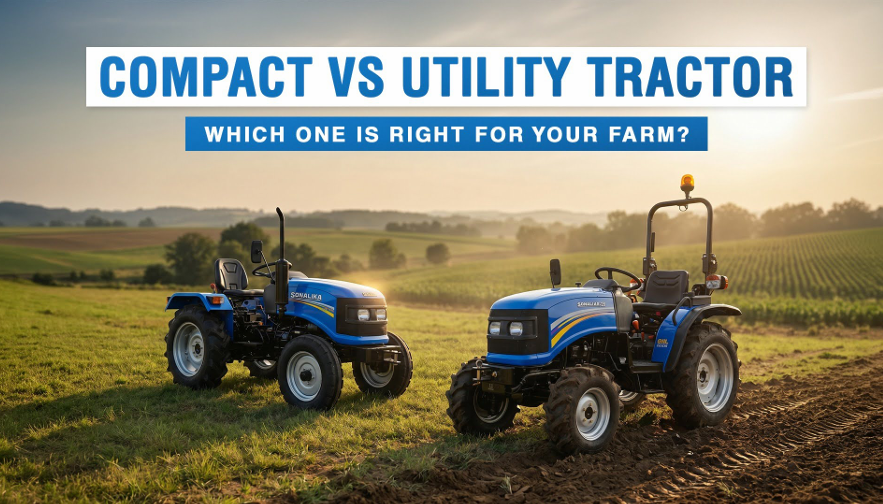
Owning the right tractor can make everyday farm work a lot easier, particularly when space, budget, & workload all matter. The Compact tractor vs utility tractor debate usually comes down to what you do most often & your power requirements. A smaller property may need a nimble machine for mowing, hauling, and light loader work, while a larger task may require something stronger & more capable.
If you are searching for the best tractor for small farm use, the real goal is to find the model that matches your land, your tasks, and your long-term plans without paying for more tractor than you need. On the contrary, if you’re searching for a utility tractor, it’s important to know where they work best. This guide will help you know the technical specs & operational costs to ensure you invest in a tractor that works best for you.
What Are Compact Tractors?
A compact tractor is a small-frame tractor designed for tasks that need control rather than brute force. Most models in this compact class offers engine at the 20 to 40 horsepower range, with lower operating weight, narrower widths, & shorter wheelbases than utility tractors. These details are essential because it improves manoeuvrability around barns, vines, trees, fence lines, & garden beds, ensuring you get high productivity without damaging crops or sensitive ground. Before choosing compact tractors, look at the PTO horsepower, three-point hitch category, hydraulic flow, loader lift height, & tire choice, since those determine what implements the tractor can really handle. Compact models often come with a 540 RPM rear PTO to run attachments efficiently, along with hydraulic flow rates between 4-8 GPM. This improves loader speed & steering response. For mowing, light grading, material handling, & small farms, these tractors pack enough capability without the size or fuel requirement of larger machines.
What Are Utility Tractors?
Utility tractors are mid-size to larger farm tractors engineered for heavier tasks, & their specifications tell you how capable a model really is. Many utility tractor models have engine horsepower ranges between 50 and 60 HP, with some models offering above 100 HP, depending on the series. The Sonalika 125 is an exceptional choice if you want power, sporting a 125-HP 6-cylinder engine. The PTO rpm range typically hovers from 540 to 1000 rpm, which matters because it determines what implements the tractor can power smoothly. The hydraulic flow rate can range from about 11 to 30+ gallons per minute. This determines loader response & implement performance. Most utility tractors commonly use manual gear or Synchromesh transmission, with many newer models packing Shuttle Shift or Hydrostatic units for convenience. The three-point hitch category & rear lift capacity vary by model, & heavy-duty machines like the Sonalika 125 offer up to 4500 kg lifting capacity. This is especially useful for larger implements and demanding field operations.
Compact Tractor Vs Utility Tractor: What Should You Choose?
Choose A Compact Tractor If:
- You work on small to mid-size plots.
- Applications include mowing, hauling, grading, landscaping & light tilling.
- You need easy manoeuvrability around trees, barns, vineyards, & narrow lanes.
- You want a tractor that’s easier to transport & store.
- Your implements are light-duty.
- You don’t need a high lifting capacity.
- You prioritise lower operating costs & simpler handling.
Choose A Utility Tractor If:
- You work on larger lands & manage heavier loads.
- Your tasks include loader work, ploughing, baling & pulling larger & heavier implements.
- You seek more powerful engines with higher horsepower & lifting capacity.
- You don’t have space constraints & work in open fields.
- You need a machine built for demanding operations.
Choosing The Right Tractor: Step-By-Step Guide
- List your most frequently done tasks before purchasing.
- Match the horsepower rating to the heaviest implement you want to use.
- Check turning space if you work around trees, vineyards, barns, etc.
- Evaluate the lifting capacity you need & the type of materials you want to lift.
- Factor in transportation & storage considerations before choosing a model.
- For lands under 20 acres, select compact tractors.
- For heavy-duty work on larger plots, utility tractors are a better fit.
Conclusion
The compact tractor vs utility tractor debate doesn’t have a clear winner. Instead, the right choice depends on how you work, applications, & how much power you need. The decision should include land size, job type, & long-term practicality. For many smaller farmers, compact tractors are the best choice for light operations because of their versatility & ease of use. For heavier tasks, utility tractors bring raw muscle at your disposal. If you want dependable tractors, Sonalika Ethiopia offers several compact & utility tractor models. Visit us today to buy the best tractor for small farm.