
by admin | Apr 28, 2026 | Blog
Most smallholder agricultural farms in Ethiopia range between 0.8 and 1.1 hectares, averaging well below 2 hectares. Here, every drop of diesel, every minute of productivity, & every second spent behind maintenance & equipment choice carries significant financial weight. Therefore, finding the best tractor for small farmers isn’t about choosing the most powerful one; instead, it’s about compatibility.
Selecting the wrong tractor for your small plot can lead to excessive fuel consumption, unwanted surface compaction & ultimately loss in productivity. In peak farming seasons, these factors can be frustrating & may attract losses. Sonalika Tractors offers a wide range of tractors in Ethiopia, with the DI 75 RX & Sonalika 125 being some popular monikers!
So which model should you select for small-scale farms? This DI 75 RX vs Sonalika 125 comparison blog should help you come to a clearer conclusion.
DI 75 RX vs Sonalika 125 Comparison: Engine Specs, Performance, Transmission & Practicality
Both tractors hail from Sonalika’s tried & tested heavy-duty range, but they are designed for different scales of operations. The Sonalika DI 75 RX relies on a 3,707 CC turbo-diesel 4-cylinder engine, producing a respectable 75 hp & 278 Nm of torque. Peak torque arrives early at 1,200 RPM, meaning better performance on tough applications & steady acceleration, making this compact tractor also an efficient one for mixed-crop use.
On the flip side, the Sonalika 125 takes a more powerful approach. It’s plonked with a 6,127 CC turbo-diesel 6-cylinder engine, which delivers 125 hp & a massive 475 Nm of torque. However, peak torque gradually arrives, in contrast to the snappy delivery of the DI 75 RX.
However, the higher torque & the intercooled engine design are better for high-load commercial work, challenging tillage tasks, & works on terrain.
The DI 75 RX’s engine is mated to an 8F+2R constant mesh gearbox, which is simpler to use & affordable when it comes to servicing. This is a real advantage where skilled technicians are not always available. In addition, the switchable 2WD/4WD mode assists with better control & fuel efficiency.
On the other hand, the Sonalika 125’s engine is coupled to a 24F+24R Synchromesh transmission, offering more effortless gear changes, versatility on different lands, fully-matched reverse speeds & better durability for heavy runs.
| Specification |
Sonalika DI 75 RX |
Sonalika 125 |
| Engine Type |
3,707 CC turbo-diesel 4-cylinder |
6,127 CC turbo-diesel 6-cylinder |
| Horsepower |
75 hp |
125 hp |
| Torque |
278 Nm @ 1,200 RPM |
475 Nm |
| Rated RPM |
2,200 RPM |
2,200 RPM |
| Gearbox |
8F+2R Constant Mesh |
24F+24R Synchromesh Gear Box |
| Drivetrain |
4WD/2WD |
4WD |
| Max Speed |
35.75 km/hr |
40 Km/hr |
| Machine Weight |
2,610 kg |
4,665 kg |
DI 75 RX vs Sonalika 125 Comparison: Lift Capacity & Implements Compatibility
Lift capacity & PTO speed are among the most important specifications you should know while inquiring about Sonalika DI 75 RX price and features. It determines which implements your tractor can run efficiently without straining the hydraulics & engine.
The Sonalika DI 75 RX offers a lift capacity of 2,000 kg, which is sufficient for smallholder implements like ploughs, rotavators, seeders & smaller loader attachments. The massive 4,500 kg lift capacity is one of the most impressive Sonalika 125 tractor specifications, meaning it can easily handle heavy disc harrows, large balers, & commercial-grade attachments on heavy-duty applications.
But does more lift capacity always mean better? The answer depends on your tasks & what implementations you are considering. If you’re associated with light-duty work, the 2,000-kg lift capacity should be enough & buying the Sonalika 125 here may cause an operational pitfall. For heavy applications, though, the Sonalika 125 is what we’d recommend.
The standard PTO speed globally is 540 RPM & the DI 75 RX delivers the same, meaning the engine doesn’t have to run at full throttle to power standard implements. This lowers fuel consumption while using implements.
The optional 1000 RPM PTO speed is among the other exceptional Sonalika 125 tractor specifications. It is designed for high-speed & heavy commercial implements, but for small farms, which often include using rotators or threshers, the higher PTO speed adds costs unnecessarily without returning practicality.
| Specification |
Sonalika DI 75 RX |
Sonalika 125 |
| Hydraulic Lifting Capacity |
2,000 kg |
4,500 kg |
| 3-Point Linkage |
CAT-II |
CAT-II |
| Hydraulic System |
Electronic Hydraulic Response (EHR) |
EHR with position & draft control |
| Auxiliary Hydraulic Circuit |
1SA/DA |
3DA/2SA |
| Loader Attachment |
Compatible with an easy front loader |
Available |
| PTO Speed |
540 @ 1,680 ERPM |
540/540E/1000 (optional) |
| Drawbar/Hitch |
Swinging drawbar |
Ladder hitch |
DI 75 RX vs Sonalika 125 Comparison: Fuel Efficiency & TCO
Running costs are where the Sonalika DI 75 RX & Sonalika 125 strongly differ. The smaller turbo-diesel 4-cylinder unit & the 2WD/4WD switchable drivetrain allow the DI 75 RX to deliver superior fuel efficiency, meaning lower running costs & more profits for small-scale farms.
The Sonalika 125’s larger turbo-diesel 6-cylinder engine with 24F+24R & standard 4WD mode may not be the perfect fit, as it consumes significantly more diesel. If you’re working on small farms, the running costs will be higher, which is not always aligned with profitability.
The DI 75 RX is also mechanically simpler, which can be a big advantage if your worksite is 50-100 kilometres away from the service centre. The 24F+24R, while smoother, is less durable & may need more maintenance. Sonalika tractor price for both models also differs, with the DI 75 staying on the more affordable side for most small farmers.
| Specification |
Sonalika DI 75 RX |
Sonalika 125 |
| Fuel Tank Capacity |
65L |
150L |
| Engine Complexity |
4-cylinder; simpler service |
6-cylinder, intercooled, needs more service |
| Transmission Serviceability |
Constant Mesh; easier to service & low-cost |
Synchromesh; costlier & needs skilled mechanics |
| Cabin Option |
Not Available |
Optional HVAC |
| ROPS/Canopy |
Standard |
Standard |
| Complexity Of Parts (est.) |
Lower |
Higher |
Verdict
Both tractors uphold Sonalika’s core values: performance, reliability, efficiency & cost-effectiveness, but while buying, evaluate factors like Sonalika tractor price, implements compatibility, TCO, maintenance & whether the machine is ideal for your requirements.
Choose the Sonalika DI 75 RX if:
- You want the best tractor for small farmers
- Your farm is between 0.5 and 2 hectares.
- You operate in mixed crop cycles.
- You need 2WD/4WD flexibility for varied surface types.
- Your work requires light implements & can suffice with a 2,000 kg lift capacity.
- If you prioritise serviceability, lower fuel consumption & easy parts access
- You’re looking for the optimal balance of Sonalika DI 75 RX price and features curated for small farms.
Choose The Sonalika 125 If:
- You work or manage farms of more than 40 acres.
- Commercial farming operations
- Sonalika 125 tractor specifications include higher PTO power & higher hydraulic lift capacity for using heavier implements.
- You’re looking for farming precision & need an advanced gearbox.
- You’re looking for optional features like an HVAC cabin for better comfort.
- You can afford a higher Sonalika tractor price & TCO
by admin | Mar 30, 2026 | Blog
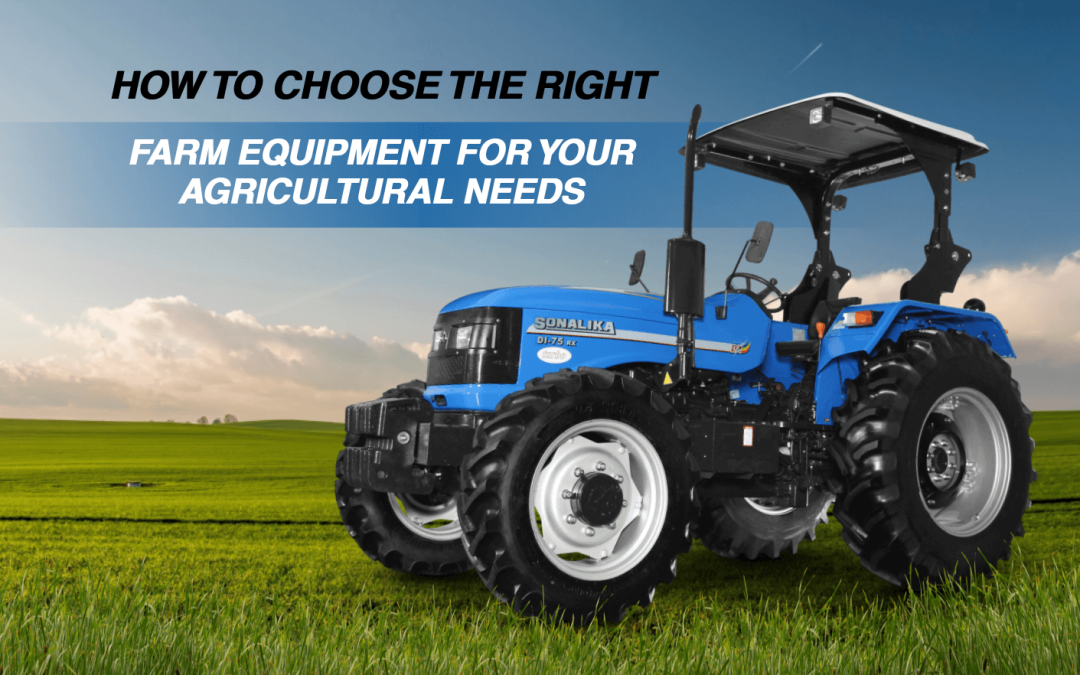
Selecting the appropriate farm equipment is vital for improving productivity and lowering operational costs in the agricultural sector. Before investing in machinery, farmers must consider land size, soil type and crop patterns. Understanding how to choose farm equipment allows us to avoid unnecessary expenses and attain better efficiency.
Farming has witnessed enhanced accuracy and speed with the introduction of modern agricultural machinery. This farm machinery guide helps farmers to select the right equipment designed for Ethiopian agricultural conditions.
Understanding Your Farm Requirements
The first step in choosing farm equipment is to assess the farm conditions carefully. Land size, terrain, and soil type are the direct factors that determine the type of machinery needed. Compact tractors are ideal for small farms, whereas high-power machines are for large farms. Correct equipment matches the real needs to enhance productivity and cost-effectiveness.
Importance of Tractors in Farming Operations
Tractors are one of the most important types of farm equipment in agricultural activities. They are used for ploughing, sowing, hauling, and multiple field operations. A reliable tractor enhances productivity across the entire farming cycle. This makes it a core element in any farm machinery guide.
Sonalika Tractor Range in Ethiopia
Sonalika tractor offers solutions to all farm sizes while assessing modern agricultural machinery. Their models are designed to accommodate Ethiopia’s diverse terrain and the cropping patterns.
Compact & Light-Duty Range (20-30 HP)
Compact tractors have superior manoeuvrability and fuel economy when used in small farms and inter-cultivation. Sonalika 20 HP tractor and Sonalika 26 HP tractor are perfect to use in light operations and smaller landholdings.
Utility & Mid-Range (50-75 HP)
Medium-scale farms require balanced power for ploughing, sowing, and transportation. The Sonalika 50 HP tractor and Sonalika DI 75 RX tractor are powerful enough for these operations, yet highly fuel efficient.
High-Power & Commercial Range (90-125 HP)
Large farms demand more horsepower for heavy-duty operations and faster output. Sonalika 90 HP, 110 HP, and 125 HP tractors are designed for commercial farming and long working hours. These tractors support a variety of implements that make it a one-stop solution for choosing farm equipment.
Matching Equipment with Farming Needs
Understanding various types of farm equipment assists farmers in selecting the appropriate equipment at each stage of farming. Tractors can be paired with ploughs, cultivators, seed drills, and trailers. The usage of compatible implements improves the overall efficiency and reduces labour dependency. This approach is required in any structured farm machinery guide.
Benefits of Modern Agricultural Machinery
Use of modern farming machinery has notably enhanced farming. Benefits include faster operations and precision in the fieldwork. Sonalika tractors are super durable, fuel-efficient, and easy to operate. These features make them suitable for Ethiopia’s challenging agricultural conditions.
Tractor Buying Tips for Smart Investment
Following the right tractor-buying tips can assist the farmers to make better long-term decisions. Key factors to consider include:
- Choosing the correct horsepower based on farm size
- Ensuring good fuel efficiency to minimise the operational costs
- Focusing on durability for the long-term reliability
- Checking strong after-sales service for smooth performance and maintenance
Conclusion
Selecting the right machinery is necessary to attain efficient and profitable agriculture. Farmers can easily align their investments with real agricultural needs by understanding how to choose farm equipment. Assessing the different types of farm equipment and applying practical tractor buying tips results in better productivity and cost savings.
Sonalika tractors offer reliable solutions for big and small-sized farms in Ethiopia. Farmers can enhance efficiency, reduce labour, and produce a more sustainable and productive agricultural future with advanced modern agricultural machinery.
