
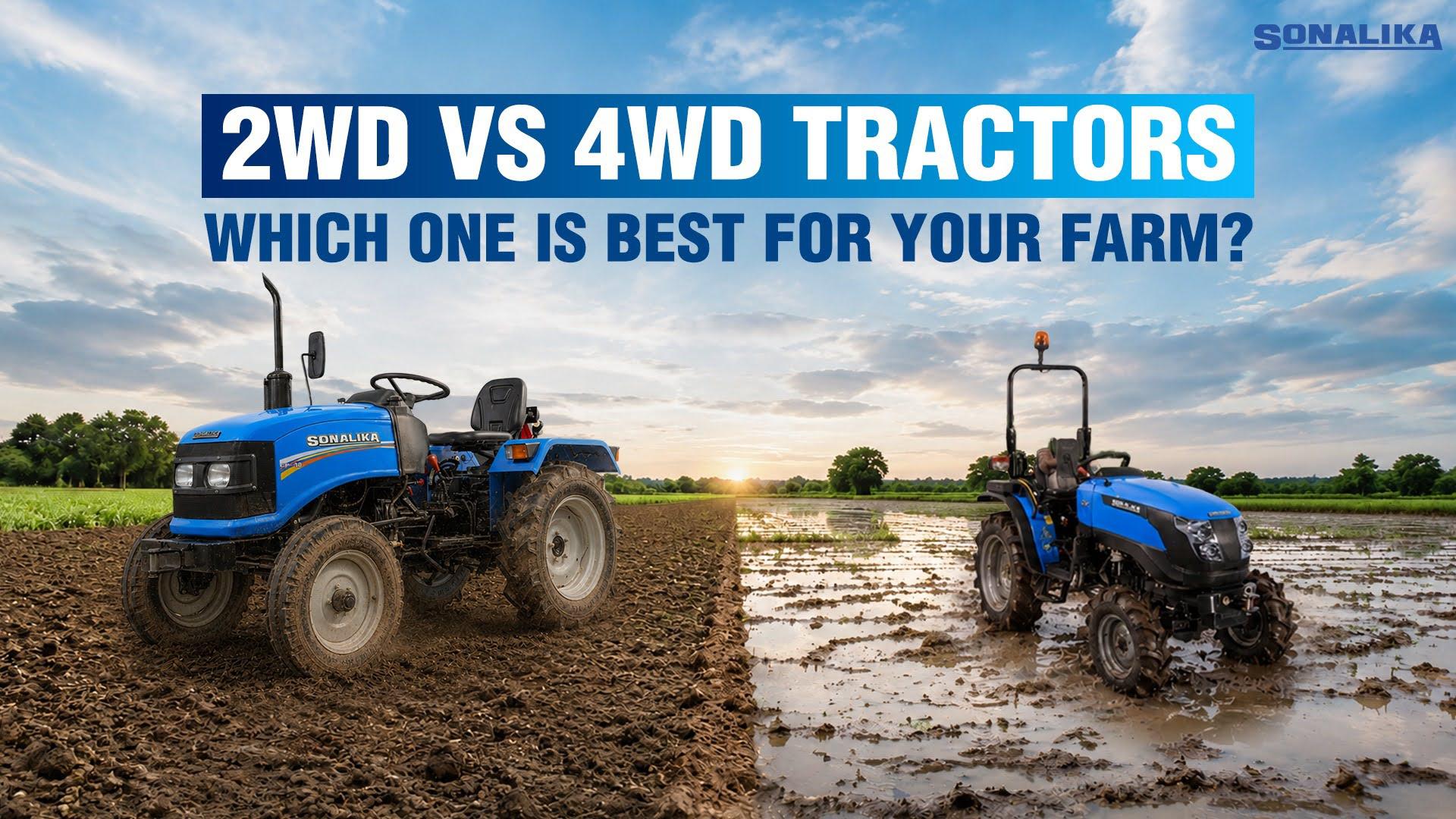
Buying the wrong tractor isn’t just costly; it can mess up your planting schedule, burn extra fuel doing the wrong jobs, and cause your tractor to stall on muddy or sandy surfaces. While a 2WD and a 4WD tractor look identical, they have key differences, and each behaves differently when you use them on dirt. One farmer working using a tractor on dry land may do just fine with a basic machine, but one working with clay or hills needs a machine with more grip.
That’s where the whole 2WD vs 4WD tractor debate steps in. Many first-time buyers think having more power or more wheels makes a tractor better, but that’s not always true. Each drivetrain is designed for specific needs, and if you mess up, your bottom line is compromised. In this farm tractor guide, we’ll discuss the differences between a 2WD and 4WD tractor, the benefits and help you find out which one suits you better.
What Is A 2WD Tractor?
A 2WD tractor sends all its engine power to the rear axle, which means your tractor’s grip heavily depends on the treads of the rear tyres, the weight of the ballast and the condition of the soil. That kind of setup shines on dry, hard fields where wheel slip barely happens, so you burn less fuel and put less wear on the machinery.
But things change fast if the ground gets loose, wet, or while using the terrain. In many cases, the rear wheels start to spin, and you lose that traction under load. That’s when weight distribution really matters, especially if you’re pulling a plough or towing a trailer. For small or medium-sized farms where the soil is consistent, a 2WD tractor makes sense. It keeps costs down and gets the job done.
What Is A 4WD Tractor?
A 4WD tractor sends engine power to both the front and rear axles, allowing all four wheels to pull together. This is possible through components like a transfer case, front differential, and drive shafts that balance out the torque, even when you’re turning. On the field, this results in way less wheel slip, so you’re not wasting engine power spinning tyres, you’re getting work done. This is critical if you’re operating on wet soil, deep tillage, or rough terrain.
4WD tractor benefits go beyond better grip. A 4WD stays steady under heavy loads, especially if you’re using a front loader or handling large implements. The extra stability matters when the balance shifts. Of course, you’re also dealing with more mechanical parts, which means more maintenance and higher fuel use, especially if you’re mostly doing lighter work.
If your farm has solid and predictable ground, you probably won’t need all that 4WD capability. But when things get tough, while operating on muddy and hilly terrain, or when you’re using heavy implements, the better performance and less downtime can easily make the bigger investment worthwhile.
4WD tractors undergo extreme stress. Watch this video to know how to inspect the oil level & fuel filter.
2WD vs 4WD tractor: Key Differences
| Factor | 2WD Tractor | 4WD Tractor |
|---|---|---|
| Traction/Grip | Moderate, ideal for paved and firm surfaces | Strong, best for loose, uneven and sticky ground |
| Power Distribution | Rear wheels only | Gets power on all wheels |
| Fuel Economy | Higher and puts less load on the engine | Lower, puts more load on the engine |
| Purchase Price | Costs lower upfront | Higher upfront costs |
| Turning Radius | Tighter | Wider |
| Maintenance Complexity | Simpler to maintain | More parts, more complex to maintain |
| Ideal For | Light & medium-farming tasks | Heavy-duty applications and work in terrain |
2WD vs 4WD tractor: Applications
| Farm Soil/Surface Type | Recommended Drivetrain |
|---|---|
| Flat, dry land, tractor with light implements | 2WD |
| Wet, muddy, sandy & hilly farms | 4WD |
| Small to medium-acre farms | 2WD |
| Large-acre farms | 4WD |
| Heavy implements: rotavators, loaders, & tillers | 4WD |
| Budget-conscious & first-time buyers | 2WD |
Which Tractor Is Easier To Maintain?
A 2WD tractor is easier to maintain since it uses fewer moving parts. These tractors don’t have a front differential, no extra universal johns or additional hydraulic lines to service, meaning fewer parts can wear or leak. With 2WD tractors, maintenance stays limited to the engine, rear axle, hydraulic system, filters, and brakes, unless some other issue pops up.
On the other hand, a 4WD tractor needs more attention because of its front axle, transfer case and steering linkages. Parts for these systems usually cost more when you want to replace. If you don’t have access to parts, good after-sales service or mechanics, a maintenance gap can be a big headache in ownership.
It’s also one of the reasons why Sonalika tractors are so popular in the market. Our tractors not only come with highly durable tractors, but also after-sales service and quality OEM parts are widely available.
Watch How To Replace Your Tractor’s Engine Oil & Oil Filter
Resale Value: 2WD Vs 4WD Tractors
4WD tractor benefits also includes lower depreciation. They usually hold resale values better compared to 2WD machines in regions where buyers have to work in wet seasons or hilly areas. Since demand for the best tractor for agriculture is often higher year after year, 4WD tractors are generally preferred in this aspect.
Dealers also price used 4WD machines at a smaller depreciation gap compared to their original cost, especially if the 4WD system is well-maintained. 2WD machines depreciate faster, especially in areas where farmers want machines with all-terrain and all-season capabilities. However, they sell well in dry farming belts.
Want The Best Tractor For Agriculture? Common Mistakes To Avoid
- Horsepower Obsession: Focusing only on horsepower and torque without evaluating the type of soil, traction requirements and plot conditions.
- Skipping Field Testing: Relying solely on dealer demos instead of testing the tractor on your land.
- Underestimating Implement Load: Ignoring the weight of your implement and not knowing PTO requirements.
- Short-Term Thinking: Considering only the purchase price, not factoring in long-term fuel costs and maintenance expenses.
Expert Tips For First Time Tractor Buyers
- Implement Consideration: Choose a tractor based on the requirements of your implements. Don’t choose based on the heaviest implement; choose based on the hardware you commonly use.
- Real-World Testing: Always operate a tractor on wet, muddy, sandy, sloped surfaces and terrain to find how well it works.
- Parts Availability: Buy models from brands offering strong local spare part support.
- Brand Credibility: Buy tractors from reputed manufacturers to ensure your tractor maintains a good resale value.
- Fuel Efficiency: Select models offering higher fuel efficiency and evaluate fuel usage under real working conditions.
Final Thoughts
In the 2WD vs 4WD tractor debate, specs listed on a brochure only tell a part of the story. What really matters is the soil, terrain, and how much you want to spend. If your farm is small and mostly dry, a 2WD usually gets the job done without any issues. If you’re dealing with sloping fields or heavy, muddy soil, 4WD tractor benefits like better grip and more pulling power are definitely worth mentioning.
Sonalika International gets that farmers have different needs, so they offer a pretty wide selection of both 2WD and 4WD tractors. That way, you can actually pick a machine that fits the land you’re working, not just what sounds good on paper.