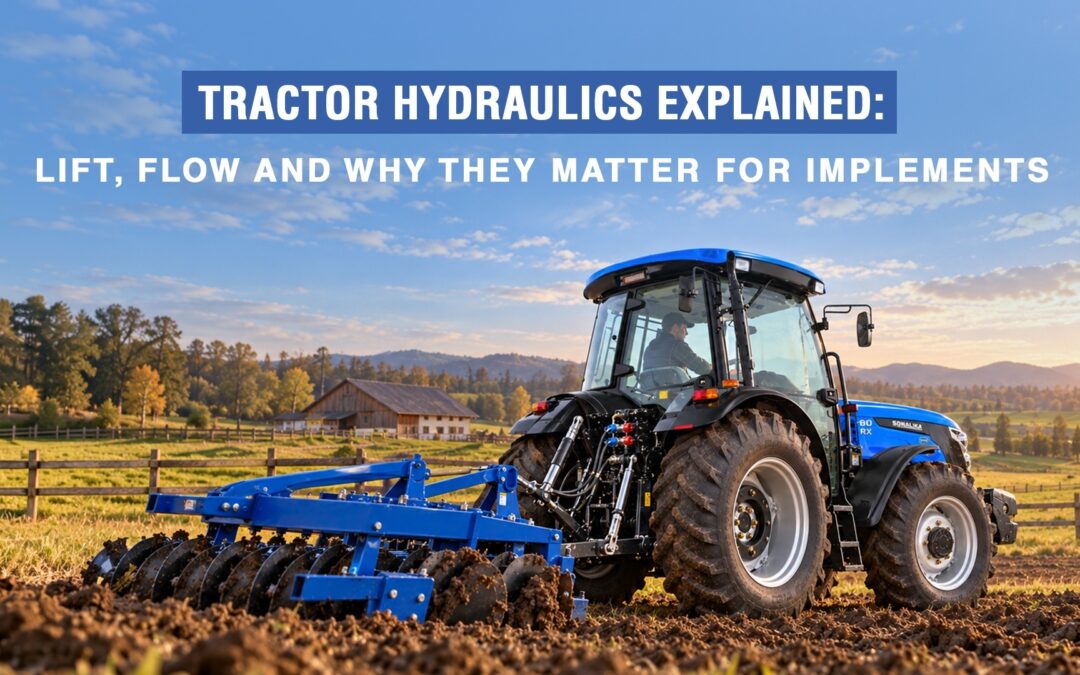
Have you ever wondered how your tractor runs its implements during tough applications like loading, cultivating, and tillage operations? Well, tractor hydraulics are responsible for running the implements, and they decide whether an implement works well or just hangs off the back. Pair a rotavator or a front loader to your tractor judging by only the horsepower, and the hydraulics may struggle to lift or slow down your operations on every cycle.
Tractor hydraulic lift capacity decides how much weight your machine can raise. Flow, however, sets the speed of the hydraulics. Both are different metrics, and more flow doesn’t provide you with more lifting capacity. If you confuse the two metrics, it shows up as a slower pace during work, strain on equipment, wasted fuel, or the implement failing to work properly.
In this guide, we’ll explore the tractor hydraulic system in detail and the difference between hydraulic flow, pressure, and lift capacity. We’ll also discuss how these factors affect implements and what to check before you buy a machine. Sonalika International is among the world’s leading tractor manufacturers, ranked 5th. Meanwhile, if you want to explore reliable and durable tractors, check out our range.

Tractor Hydraulic System & Three-Point Hitch Explained
The hydraulic pump in your tractor runs off the engine, and it pushes oil through the valves to the cylinders. The cylinders use the oil to pressurise and convert it into movement. Instead of using mechanical gears or belts to move heavy loads, tractor hydraulics use pressurised fluid, pumped through hoses, valves and cylinders to run implements.
Raising and lowering implements are the most visible jobs a tractor does. Here, a three-point hitch takes the stage. A three-point hitch explained simply, is when two lower links and one top link carry an implement and the hydraulics raise or lower them. Compact tractors usually use Category 1 hitches, while mid-range models come with Category 2. High HP tractors generally come with Category 3 hitches to run heavy implements.
Tractors like the Sonalika FP-18 and Sonalika 30 are packed with CAT-1 linkages. Higher models like the Sonalika 50, Sonalika 75 WT, Sonalika 110 WT and Sonalika 125 run on CAT-2.
The same oil also runs outside the work. Implements like loaders, tipping trailers and other tools that are remote-operated draw oil from auxiliary circuits present on a tractor. Two controls matter in the field. Position control holds an implement at a specific height, while draft control senses the load on an implement to adjust the depth, which helps on uneven soil.
Tractor Hydraulics: Lift Vs. Flow Vs. Pressure
These three metrics often get mixed up among farmers and owners. However, they have different functions:
Hydraulic lift capacity is the amount of weight the rear linkage can raise. It is quoted in kg or lbs. Lift capacity comes from the pressure acting on the lift cylinder’s piston area, so flow has no say over it.
The hydraulic flow rate is the amount of hydraulic fluid your tractor’s hydraulic pump moves. It is measured in litres per minute (LPM) and determines the speed of the tractor hydraulics. Higher flow raises an empty linkage more quickly and leads to a quicker cycle of a loader or tipper. But it doesn’t necessarily make your tractor stronger.
Hydraulic pressure sits in the middle. It is capped by the relief valve, and the cap and size decide the maximum force. When you want more, the valve opens and keeps the implements up. Here is one catch you must know about lift capacity: many tractor manufacturers quote it at a set point on the lower link, while the real load hangs further back.
Always ask where the figure was measured, about the tractor hydraulic lift capacity in kg/lbs and the flow rate (in LPM), before purchasing a tractor.
Why Lift, Flow & Pressure Matter For Implements
Every tractor implement comes with a different specification. For instance, a heavy cultivator needs lift, while a front loader requires flow. Here, a slow hydraulic flow rate results in slow cycle times and after a full day, it adds up as lost hours. Tippers also need a remote outlet before flow enters the conversation.
Numbers related to lift are not always the same. This is because they come from test conditions of the manufacturer, and a long implement sitting far behind on the hitch can feel heavier than its actual weight. So, leave a safety margin. Numbers related to pressure matter when your load is dense, like when you’re carrying a bucket full of wet soil.
Implement manufacturers and tractor manufacturers alike publish hydraulic demands of specific implements. Always check these numbers against tractor hydraulic lift capacity and oil flow rate before you pay.
How To Match Implements To Your Tractor
- Hitch Category: Match the implement’s category (1 or 2) to your tractor’s linkage. A mismatch can require adapters or simply no fit at all.
- Lift Rating: Compare the weight of the implement in kg/lbs with your tractor’s hydraulic lift capacity. Stay below the lift rating, as mounted tools hang behind the links and often feel heavier than they actually are.
- Remote Outlets: Count the total number of outlets your loader, tipper, or hydraulic plough requires. Your tractor should have at least that many.
- Oil Flow: Compare the LPM rating of the implement and your tractor’s hydraulic flow rate. Different implements have unique requirements.
- Control Mode: When you’re using ploughs and cultivators, use draft control. This helps the hydraulics adjust depth with changing soil resistance. Use position control for implements that need fixed working heights, for example, rotavators.
- Balance: A heavy implement mounted at the rear causes the front axle to lighten. In that case, add front weight until the tractor feels planted.
- Specification Format: As for the lifting capacity in kg/lbs, flow in LPM, and pressure in bars.
Common Mistakes Owners & Buyers Often Commit
- Buying solely on horsepower because engine power says nothing about what a linkage can lift or the speed at which the auxiliary circuits move.
- Considering flow and lift as one specification. They are separate, and more flow won’t fix a lower lift capacity.
- Ignoring hitch category is another common mistake. Cat-I & Cat-II are different, and each implement has a different requirement. One may not match the other.
- Skipping auxiliary circuit checks is common. Count the circuits and determine whether they are single-or double-acting. Implements like loaders need the right type.
- Ignoring oil conditions can lead to the use of the wrong grade or dirty oil, both of which wear the pump and affect the response. Follow the grade specified in the manual.
- Running past the tractor hydraulic lift capacity again and again puts strain on the cylinder, linkage and rear axle.

Closing
Horsepower ratings tell you how hard your tractor can pull. Lift, flow, and pressure determine what it can carry and how fast it works. Check numbers related to all three metrics before you select a model, not after the tractor arrives. Numbers related to tractor hydraulics must be carefully evaluated.
Whether you want a tractor for smallholdings or light tasks, or heavier tractors for large and commercial farming, Sonalika International offers a handful of choices. Contact us today to learn more.