
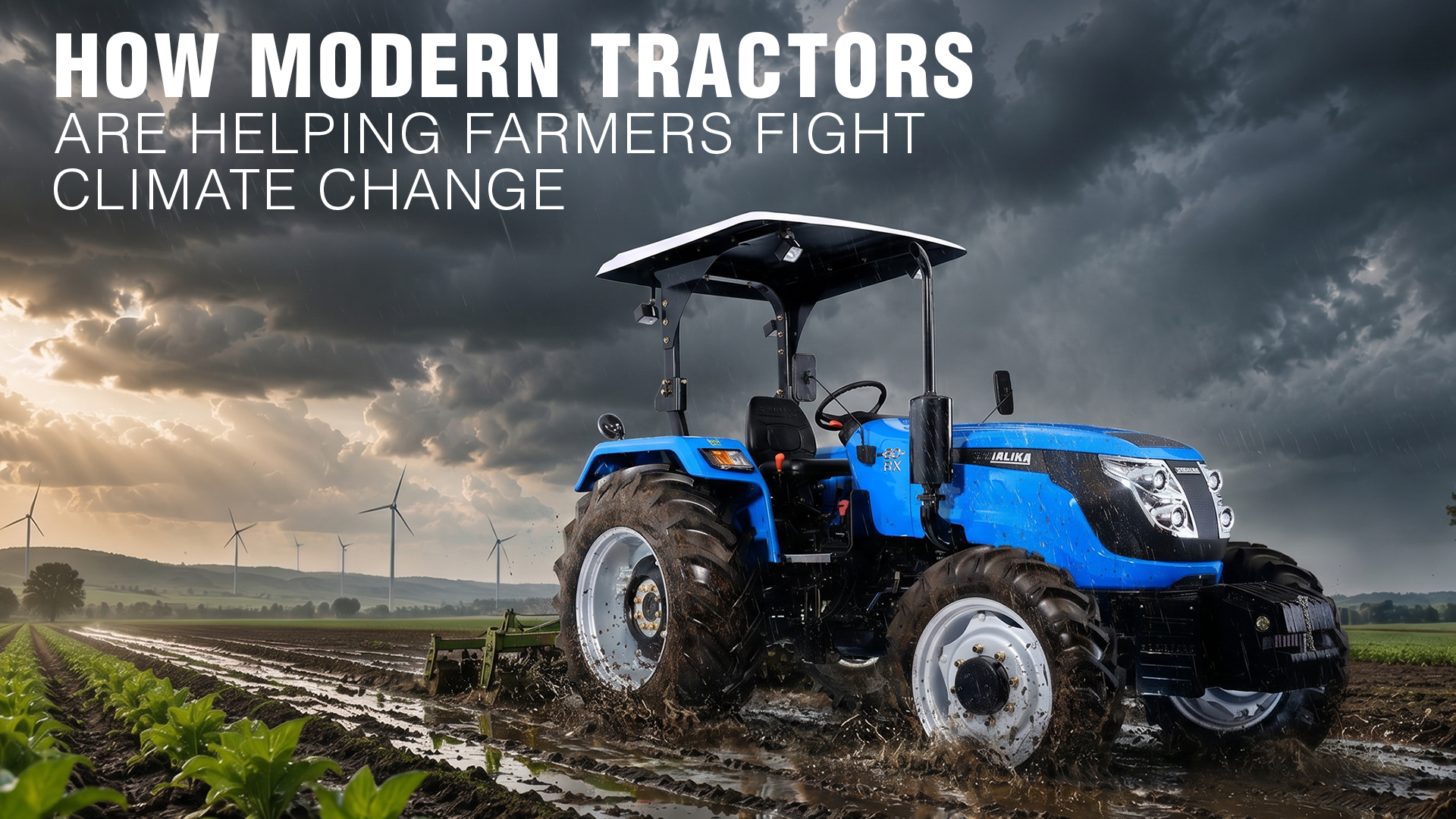
The climate emergency is a huge challenge for contemporary farming. Farmers face the challenge of balancing productivity and sustainability amid rising temperatures, variable rainfall, water scarcity, and soil erosion.
It is here that tractors for climate smart farming are helping to shape the future of farming. Today’s tractors aren’t just designed to be more powerful and productive; they’re also designed to be more fuel-efficient, less polluting, and more environmentally sustainable, and more intelligent in their field management.
Why Smarter Machinery Is Needed in Farming?
Traditional farming practices may involve excessive fuel use, too many passes over the fields, and soil that is not properly tilled. These practices will, over time, lead to higher operating costs, carbon emissions, and soil degradation.
To overcome these challenges, modern agricultural equipment is engineered with sophisticated designs, effective power transfer, and high accuracy. This transition to sustainable tractor technology is benefiting farmers to produce more with less.
Scientific research worldwide has shown that in cultivation and land preparation operations, the use of more efficient and precise machinery and farming techniques can help to lower fuel consumption and operational waste.
How Modern Tractor Engines Improve Fuel Efficiency?
Modern tractor engines are better at saving fuel in several ways. One of the biggest advancements in modern tractor technology is engine efficiency. Modern engines generate more torque at lower rpm, allowing the tractor to perform heavy work with less fuel.
Turbocharged and intercooled engines also enhance combustion quality, as the air is brought into the engine system at a cooler, denser state. This enables the fuel to burn more efficiently, whilst eliminating unnecessary exhaust emissions.
Proper cooling system and air cleaner maintenance play an important role in improving fuel efficiency, reducing engine stress, and maintaining long-term tractor performance. Watch this DIY video to understand how regular maintenance supports climate-smart farming operations.
Sonalika 75 RX is a fine demonstration of engineering for fuel efficiency in modern agriculture. It has a 4-cylinder engine of 3707 cc, 75 HP, and 278 Nm of maximum torque at 1300 ERPM.
Key Features Supporting Fuel-Efficient Farming
The following are key features supporting fuel-efficient farming:
- 12V 75 HP turbocharged engine for increased field productivity
- Achieves 278 Nm of torque at lower RPMs
- 8F plus 2R Swift Shift transmission
- 2500 kg lifting capacity (hydraulic).
- 4WD for low-slip drive conditions.
- Dry-type air cleaner with clogging sensor
- The machine delivers balanced power, helping farmers finish cultivation, haulage, and
- PTO-driven operations with better fuel efficiency over extended working time.
Precision Farming And New Technology In Tractors
In climate-smart farming, precision agriculture is becoming increasingly significant. Ensuring accurate field operations now helps farmers minimise losses of fertilisers, fuel, seed, and water resources.
This has helped advance the development of new technology in tractors, such as more sophisticated hydraulic systems, smoother transmission control, intelligent PTO management, and improved implement compatibility.
Sonalika 90 WT is designed for precision, heavy-duty farming operations. It comes equipped with a 90 HP turbocharged 4-cylinder engine producing 339 Nm maximum torque for demanding field applications.
Advanced Features Supporting Precision Farming
- 12F plus 12R synchromesh transmission
- Simplex clutch on the front and rear for smoother implement handling.
- The hydraulic’s lifting capacity is 3000 kg.
- Oil Immersed Brakes For Better Field Safety
- The 4WD system provides excellent stability in difficult terrain.
- Good ground clearance for off-road use on farms.
- The controlled gear operation and sophisticated hydraulics help ensure field accuracy for deep tillage, cultivation, and heavy implement use while eliminating unneeded field overlap.
- Protecting soil and applying technology to tractors.
Tractor Technology And Soil Protection
Climate-resilient agricultural systems depend heavily on healthy soil. Over-compaction will result in poor water uptake, impaired root growth and development, and decreased long-term crop productivity. Reducing unwarranted soil pressure is now a major concern, driven by advances in tractor technology, including better weight balance, tyres, and traction.
Sonalika 50 is intended for lighter field work, where achieving a balance between weight distribution and reduced ground pressure is critical. It has a compact design and is well-suited for power delivery, making it easy to reduce excess soil compaction during cultivation and transportation operations.
Features Supporting Better Soil Health
- Distributed weight-load for controlled field movement
- Necessary passes are avoided due to a compact turning radius.
- Reduce fuel consumption and engine performance.
- A smooth transmission for easier operation.
- It is offered in 2WD and 4WD models.
- Less soil disturbance will lead to less water loss, a stronger root system, and improved long-term field productivity.
Sustainable Tractor Technology And Reduced Emissions
Engine manufacturers are increasingly focusing on cleaner engine systems and lower-emission technologies, which are becoming increasingly important in modern agricultural machinery. This shift to sustainable tractor technology is becoming increasingly critical for the future of sustainable farming.
Fuel efficiency, accuracy, and optimised transmission layouts are now helping reduce overall fuel consumption and engine stress during heavy agricultural work. Sonalika 125 showcases the power and efficiency of high-horsepower tractors. It has a turbocharged, intercooled 6-cylinder engine with high torque, delivering 475 Nm at peak for heavy-duty field applications.
Heavy Duty Features Supporting Sustainable Farming
- A synchromesh transmission that uses both 24 gears and reverse.
- Electronic Hydraulic Response System
- Lifting capacity of 4500kg in one lift.
- Wet disc hydraulically actuated brakes
- Advanced 4WD drivetrain for improved traction
- The turbocharged intercooled engine technology.
- It is equipped with a highly tuned transmission and torque management system that minimises engine load during challenging land preparation and cultivation tasks.
Conclusion
Climate change is putting more pressure on farmers to generate more food with fewer natural resources. Efficient machinery has become the heart of enhancing agricultural productivity, accuracy, and sustainability.
Industrialised tractors for climate smart farming reduce fuel consumption, improve soil health, lower emissions, and enhance precision across various farming scenarios. Farming is evolving, and advanced machinery will continue to play a vital role in helping farmers adapt to ever-changing environmental challenges and ensure their farms remain productive and profitable in the long term.
Visit Sonalika International to learn about the latest in tractor innovation and technology and how they contribute to creating a more sustainable future in agriculture.