
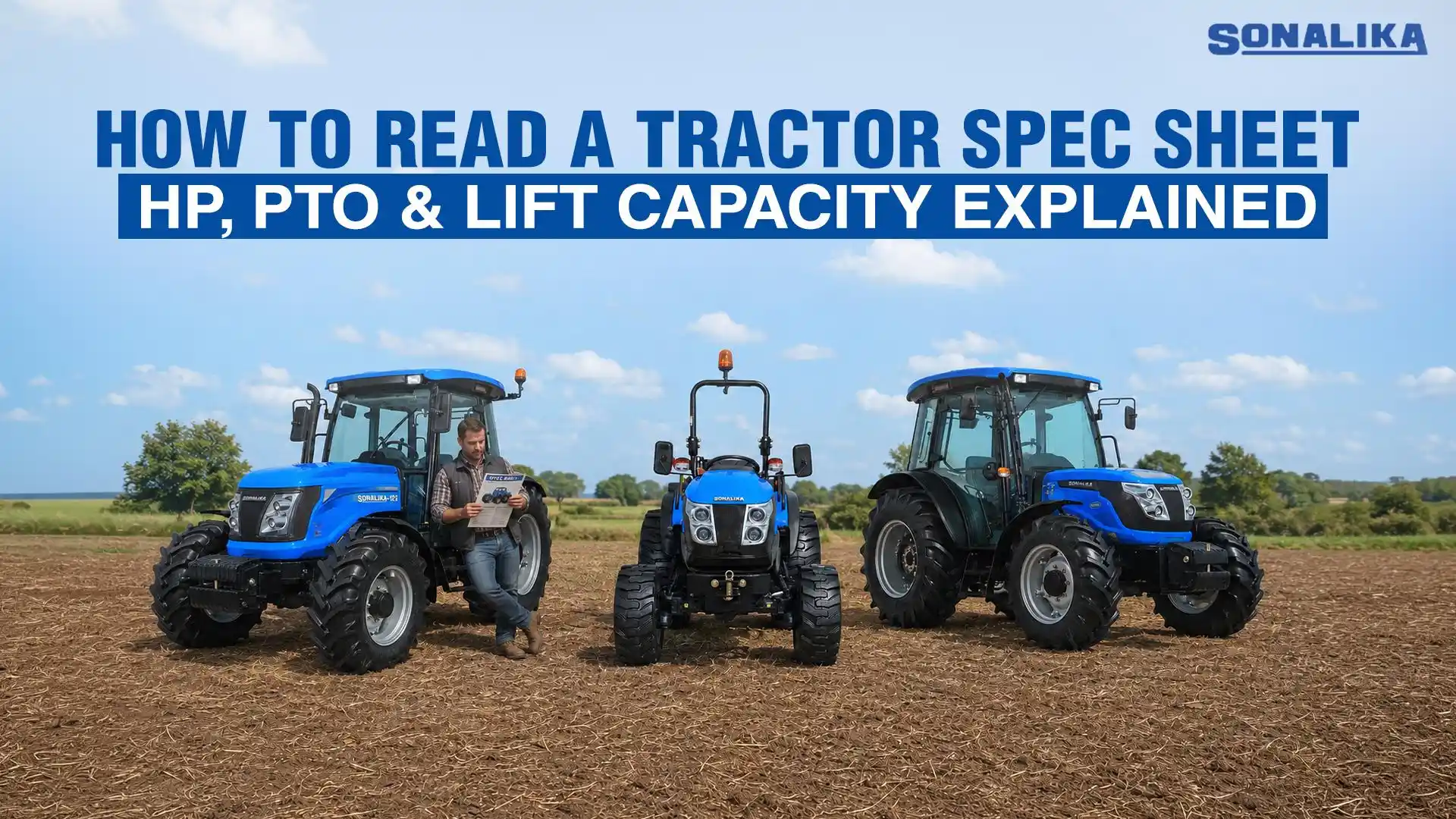
Imagine this scene: two tractors are displayed at a dealership, both having a “50 HP” sticker on them and looking very similar. In reality, both tractors can still perform differently on the farm. One tractor can easily pull a heavy rotary tiller, while the other struggles when you activate the PTO or simply cannot lift a loaded box blade off the ground efficiently.
For farmers looking for a tractor on a budget to meet tight deadlines associated with short sowing and cultivating windows, this gap between the claimed power and real-world output is where the differences lie. A wrongly matched tractor here results in wasted money. Before comparing price tags or brands, it’s important to know how to read a tractor spec sheet properly.
Knowing how to read a spec sheet properly helps you compare specifications effectively and align important specs like tractor lift capacity and tractor PTO horsepower to your real-life requirements. Below, let’s understand the main specifications of a tractor so you understand what each is and pick the right number.
Also Watch: Know Your Tractor | DIY Guide
Why Its Important To Understand The Spec Sheet?
- Tells you the real power reaching your tractor implement
- Prevents you from buying a tractor that cannot lift or run attachments you need
- Helps you compare tractor specifications across models and brands for a better purchase
- Helps you predict the total cost of ownership and running costs
- Avoid buying underpowered or overpowered tractors
Engine HP
An engine’s horsepower is the amount of maximum power your tractor’s engine is designed to make. Sometimes listed as gross HP or flywheel HP, it measures the output of an engine before power is lost to the transmission, alternator, hydraulics, or cooling fan. The engine HP is the number every leaflet leads with since it’s the most flattering figure available. However, treat it as a starting point of reference only. If you want tractor HP explained in simple terms, this number tells you a tractor’s raw potential, not what reach to the field.
Engine Torque
Alongside horsepower, your tractor’s engine also delivers torque, measured in Nm or lb-ft, depending on where you reside. Torque, sometimes nicknamed punch, is an engine’s twisting force, and it matters more than HP when you’re putting your machine under loads, tasks like ploughing dense soil or pulling a loaded trailer. A tractor with strong low-end torque holds a machine well and reduces the chances of stalling or needing downshifting. Additionally, good low-end torque also results in lower fuel consumption.
PTO Horsepower
Every tractor has a specification called PTO horsepower, a short form for power takeoff horsepower. Tractor PTO horsepower is the power available at the rear shaft to drive implements like rotavators, mowers, balers and sprayers. It reflects the power left after drivetrain losses and is usually 10-20% lower than the engine HP. PTO type and speed are equally important as the number!
PTO Horsepower Type & Speed
Most tractors come with a 540 RPM PTO, with certain models offering a 1000 RPM PTO for using more demanding implements. There is also a 540E PTO type, which allows you to run an implement in lower engine speeds for better fuel economy. Pairing an implement with the wrong tractor PTO horsepower or speed can damage the transmission and cause breakdowns. Before using an implement, check the PTO horsepower, speed rating and whether it’s independent, live or transmission-driven.
Hydraulic Lift Capacity
A tractor’s hydraulic lift capacity determines the maximum weight the three-point hitch can safely raise from the ground. The lift capacity is very important for mounted ploughs, seed drills and rear blades. This number depends on the size of a tractor’s hydraulic cylinder and the linkage geometry, not on engine power. A tractor with a high-HP engine may still struggle to lift heavy implements if it has a weak hydraulic system.
3-Point Hitch Category
The hitch category is the physical dimensions of a tractor’s linkage arms and pins. Hitches are divided into standardised categories, and they are based on the size and pin diameter of a tractor. CAT-1 (category 1) is usually found on small and compact tractors, while CAT-2 is usually present on mid-sized tractors.
Once you climb the ladder with larger tractors, CAT-3 is present on large tractors and agricultural machinery to handle heavier implements. You must match the hitch category with your current implement, as the wrong category can lead to replacements of expensive adapter kits or buying new attachments.
Also Watch: Three Point Linkage & Rotavator Hitching & Unhitching | DIY Guide
Hydraulic Pump Flow
Measured in litres per minute (LPM), hydraulic pump flow determines the speed at which oil reaches loaders, hydraulic cylinders, and remote valves. This indicates the speed and responsiveness of your hydraulic system. A front loader generally needs a high flow rate to lift and dump materials efficiently. If the flow rate is too low, cycle times are delayed, and this affects your site productivity. For contractors using front loaders or tippers, the flow rate influences productivity more than HP.
Transmission & Gear Speeds
Tractors are available with several transmission types and gear counts, but the right transmission enhances your operational efficiency. Transmission consists of forward and reverse gears, with options like Sliding Mesh, hydrostatic, and powershift. More gears deliver better control over speed, which allows you to match the pace you want during seeding. Shuttle shifts are better for loader work as they allow you to change direction instantly without stopping to change gears.
Drivetrain: 2WD & 4WD
Tractors come with two drivetrain options. When you compare tractor specifications, you find affordable and daily-use models fitted with a 2WD, meaning only the rear wheels rotate. This has its own set of pros and cons. The pros are better fuel efficiency and less complex maintenance, and the cons include less traction and control on terrain, muddy conditions or slippery farms.
4WD systems are better in many aspects and are found on tractors designed to conquer various surfaces. They are equipped with limited-slip differentials for better grip on rough and slippery surfaces, but consume more fuel compared to a 2WD and are more complex to maintain.
Tractor Weight, Dimensions & Ground Clearance
Every tractor has its own weight. A heavier tractor can effectively transfer the power to the surface, compared to a lighter machine. The weight and wheelbase dimensions determine turning radius, ride comfort and stability. Tractors with high ground clearance are better if you’re using them on terrain and on farms, since they minimise the chances of damaging crops during harvesting or spraying.
Tire Size & Track Width
Tires are the only contact point with the ground. When you learn how to read a tractor spec sheet, understanding tyre size and track width is very important, as the type of tyre determines a tractor’s performance, safety and stability. When you compare tractor specifications, many models offer optional tyre configurations based on buyer needs.
A tyre affects traction, soil compaction, crop damage and overall stability. Always choose tyres based on primary application, because a tractor with a good engine and loader performance may struggle in the field if the tyres don’t match the surface.
Fuel Tank Capacity
The fuel tank determines how long you can use the tractor before needing a refill. A machine with a larger tank capacity can store more fuel and keep the machine running continuously during long working hours, and maximise your daily productivity. Once you check this number with the expected fuel consumption numbers, you can have a clear range.
Frequent refuelling interruptions cost fleet managers their valuable time an labour. A larger tank can save a significant amount of time by reducing refuel rates.
Conclusion
Once you know how to read a tractor spec sheet, you can transform a risky purchase into a smart and data-backed investment. By understanding what usable power and hitch ratings are, you can compare specifications easily to find the perfect fit. Matching these numbers with your requirements reduces fuel wastage and maximises operational efficiency.
Ready to buy tractors? Sonalika Tractors are a globally renowned tractor brand, offering an expansive range of tractors and implements. Our tractors promise exceptional performance, reliability and durability. Contact us today to learn more.